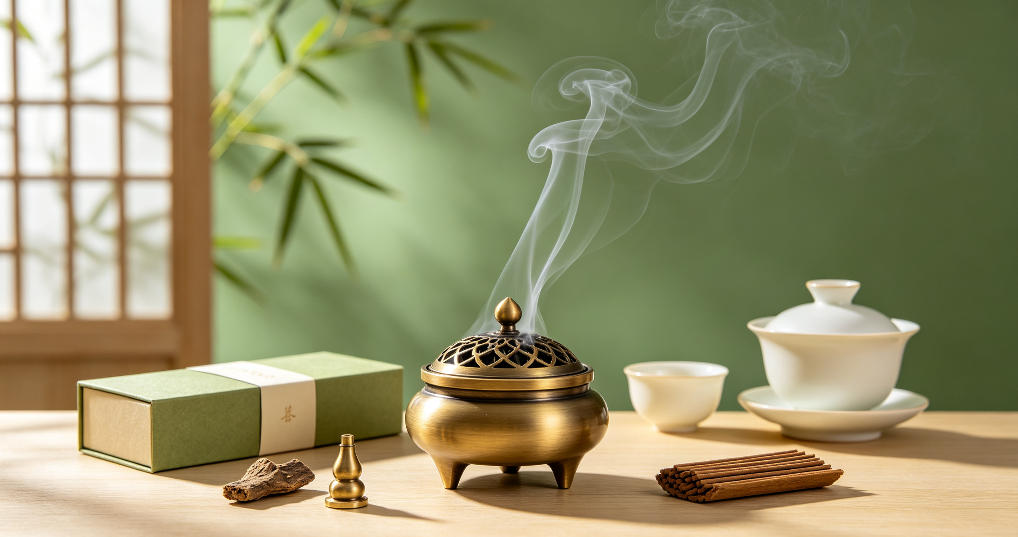
A fragrant path leading to inner peace. When wispy smoke spirals upward from a bronze censer, carrying soft, layered natural aroma, you step into the world of Xiangdao — China’s profound, living aromatic heritage spanning more than five thousand years.
1. Origins: From Sacred Ritual to Literati Elegance
The history of Chinese incense traces back to the Neolithic Age. During the Shang and Zhou dynasties, our ancestors burned mugwort, cedar and fragrant herbs to worship deities and ancestors, believing smoke acted as a messenger bridging mortal and divine realms, a custom documented in classics like The Book of Songs and The Book of Rites.
The Han Dynasty brought transformative change: the Silk Road transported agarwood, frankincense, myrrh and sandalwood from Southeast Asia and the Middle East into China. Local herbalists blended imported aromatics with native botanicals, inventing the craft of Hexiang (composite natural incense), shifting incense from exclusive sacrificial use to daily imperial and scholarly life.
The Song Dynasty marks the golden age of Xiangdao. As urban culture flourished, appreciating incense evolved into a sophisticated ceremonial art. It stood equal to tea, flower arrangement and painting as the Four Gentlely Arts for intellectuals. Scholars built dedicated incense chambers, collected exquisite porcelain and bronze burners, and hosted formal incense parties. They lit incense to calm the mind while composing poetry, reading classics or playing guqin, viewing fragrance as a medium to touch the quiet beauty of the universe. Ming and Qing dynasties further perfected incense tools, blending formulas and ritual standards, cementing Xiangdao as a complete cultural system integrating art, medicine and philosophy.
2. Core Philosophy: Harmony Between Human and Nature
The word “Dao” in Xiangdao embodies the core logic of Chinese civilization: the universal natural law of balance. This art is never just about enjoying a nice scent; it is a spiritual practice centered on three pursuits:
- Physical wellness: All traditional incense blends are crafted from medicinal herbs in line with Traditional Chinese Medicine theories, soothing nerves, purifying air and regulating inner vitality (Qi).
- Mental cultivation: Practitioners follow strict, slow rituals of grinding powder, pressing incense seals, heating censers and appreciating smoke. The deliberate pace calms racing thoughts, a practice similar to silent meditation. Ancient Chinese call it “listening to incense” — using the sense of smell to quiet the heart, rather than merely smelling fragrance.
- Cosmic harmony: Rooted in Taoism’s pursuit of unity with nature, Confucian virtue cultivation and Zen’s mindfulness, Xiangdao teaches humility, focus and gratitude. The fleeting smoke reminds practitioners of life’s impermanence, encouraging gentle, grounded living.
3. Ritual, Craft & Aesthetics
A complete Xiangdao ceremony relies on a full set of elegant handcrafted tools: incense spoons, ash presses, bronze tongs, porcelain censers and carved incense moulds. Practitioners grind natural raw materials, mix them by precise ancient recipes, and shape them into line incense, coil incense, or artistic incense seal patterns.
All raw materials are purely natural: agarwood, sandalwood, osmanthus, green tea, borneol, mugwort and many wild aromatic plants, without any synthetic additives. Unlike modern commercial fragrances that create an overpowering single scent, Chinese incense unfolds in layers: soft top notes, mellow middle aroma and lingering deep base notes, changing subtly as the incense burns.
Eastern minimalist aesthetics define Xiangdao spaces: plain wooden tables, soft natural light, simple tea sets and scroll paintings, forming an immersive quiet sanctuary. The art often pairs with tea ceremony, guqin music or calligraphy, forming a complete Eastern slow-living aesthetic system.
4. Xiangdao Today: A Living Heritage for Modern Times
After centuries of inheritance, Xiangdao is now revitalized as a national intangible cultural heritage of China. It breaks free from old stereotypes of temple-only incense, emerging as a lifestyle embraced by young people.
Modern Xiangdao studios host public experience sessions, blending ancient formulas with contemporary living spaces. New creators develop portable home incense, tea-scented aromatics and natural wellness blends, passing down the wisdom of slow, mindful living to global audiences.
As a precious cultural carrier, Xiangdao tells the world China’s unique pursuit of inner peace, natural harmony and subtle beauty. A wisp of ancient fragrance carries thousands of years of Chinese thought, inviting all people to slow down, breathe gently, and find tranquility within themselves.